Tuesday, January 31, 2012

Fitting Fenders

I attached a firewall pad on the cabin side. This was originally only installed on the coupe versions but will benefit my roadster as well. Heat and sound will be dampened, plus it gives a finished look to the firewall.


The fenders were hung on the car loosely so the piping could be cut and hung. Silver/Gray piping was standard on all MGAs regardless of body colour, and although other colours are available I've kept with the original look.


The fenders were then tighten up and with a little persuasion they lined up nicely with the body tub. But the DOORS.... This car was manufactured more then 50 years ago, the tolerances, techniques  were not up to today's standards, so getting all body lines to line up to modern standards was a bit tricky. I imagine the workers on the assembly line became quite adapt at the gentle massage techniques required to get these little cars ready for the show room floor.
A lot of time was spent with the doors, gentle manipulating was needed more then once. Patients won out in the end, the body lines and door clearances turned out great and can easy compare to a modern car.


Monday, January 30, 2012

The Big Reunion

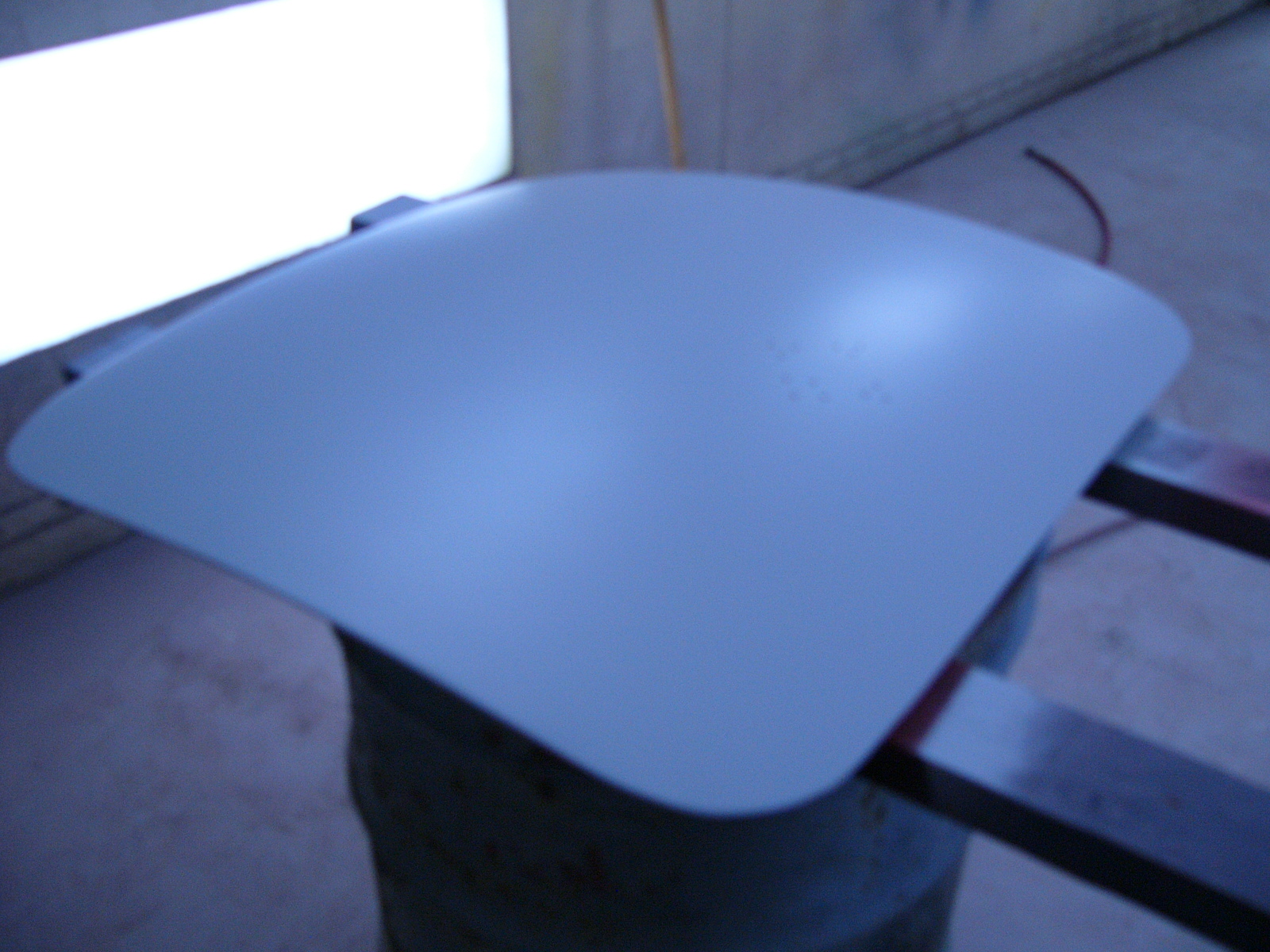
The paint turned out very nice and was worth the wait.


Some minor imperfections were polished out and soon the body was ready to be reacquainted  with the chassis.


Sunday, January 29, 2012

Final Stages of Body work

The last couple of months have brought many changes to the car. Final stages of block sanding have shown that alll the hard work has paid off. The body panels look straight and the fit of the doors appear to be right on.


Primer coat revealed no surprises


The underside if the body tub, fenders, hood and trunk lid were painted using single stage paint. The factory used nitrocelulos paint, which is unavailable today. The colour is original to MGAs... after a very long struggle with colour choice, I've decided  on MGA 1600 red Chariot Red which is a little "redder" then the MGA 1500 oriental red. The outer panels will be painted with a modern Base Clear, this will help keep the red from fading as well as be a little more durable.


Tuesday, March 1, 2011

Bodywork

A little more progress on the bodywork, although painfully slow. After completing the major bodywork, the body needed to be media blasted a final time before epoxy primer could be applied.

After the final blasting the metal needed prepping for paint:
...Finally the epoxy primer was applied.


The aluminum pieces needed to be primed using self-etching primer


Now on to the next stage; applying filler and smoothing out all surfaces. Although filler has been kept to a minimum, this final process will be time consuming. The first step will be to place all the pieces back on the body tub and lining them up in their final placement. A small amount of dolly work will probably still be done but the majority will be filling/sanding, filling/sanding, filling/sanding .........


Monday, August 30, 2010

It's ALIVE!

 .
After getting the radiator back (which turned out great), and installing it along with a proper thermostat housing, all systems were go for the initial start up.
Turning over the engine with the new starter motor for 30 or 40 seconds produced a good oil pressure...it was time for the real thing. Connecting the ignition and fuel pump to the battery, the fuel pump began ticking away until the float bowls filled. I held the choke with one hand and pulled the starter with the other. After a couple of revolutions the engine roared to life. Yahoo! No clunks or weird noises just a little water leak from the heater valve gasket. Wow a 50-year old engine roaring back to life...a great feeling!

Surprisingly the fiberglass exhaust wrap smoked quite a bit, but the only real problem was the idle. I couldn't get the idle below 2500rpm and after a couple of minutes I shut the engine off. Although the fast idle didn't wipe the smile off my face, I did want to get the problem solved before continuing with initial break-in.

Considering I rebuilt the carbs. myself I figured the problem lay with them. Checking the internet for possible causing of fast idle and S.U. carbs., the solution seemed to be with the throttle discs. The throttle discs need to be fully closed when at rest. The discs themselves are even beveled slightly so the disc can seal better in the venturi . I checked my discs and found them both open slightly and one disc was installed with the bevel the wrong way. I had drilled the holes in the new throttle shafts (for the idle stops) slightly off where they should have been. I filled in the holes with easy weld and redrilled the holes in the proper position. Now, holding the venturi up to the light with the disc closed showed them both fully closed. I reinstalled the carbs. and double checked to be sure the jets were centered, nice solid clunk when the damper piston is released.

The next day I tried again. The engine started right up and idled down to 1200 with the choke on, good. Now just wait till it gets to operating temperature and set the idle and timing. After a couple of minutes all is well the engine is running fine, with good oil pressure and the temp is rising slowly. Then, the engine dies, turns over but won't start. After checking all electrical connections I check the float bowls and they are dry. Then I realize there is no noise from the fuel pump. The fuel pump has died... after 10minute a newly rebuilt fuel pump is done...$#%@!

Oh well I guess better now then literally down the road.

I sent an email off to the fuel pump re builder guy and he says he'll make it right, so off to the post office I go.

Although I didn't get a chance to set up the engine , I am happy with the initial engine start. One major step closer to getting back on the road.


Here's a video after getting the fuel pump and Carbs worked out:

Monday, August 9, 2010

Floorboards & Chasis routing


I've run into a couple of snags while getting things together before starting the engine. Though I bench tested the starter motor and it ran fine, when I attempted to turn the engine over the starter gave up after a couple of revolutions. A new one is on its way. The radiator is also no good which does not surprise me, as it is the original rad complete with brass info plate, where when and who built it as well as serial number ( I guess in case it ever gets stolen ;-). The rad is being re cored  with a more modern core which should allow for more efficient cooling. I am only to glad to assure these important components are in good shape. The thermostat housing also turned out to be the wrong one, having a different angle on the outlet tube then the MGA version.  By the end of next week I should be close to starting the engine for the initial run in.

In the mean time :
The exhaust pipe has been  wrapped in fiberglass jacket. This should help maintain a cooler cabin temperature.


Floorboards have been installed.

Test fitting


7 layer plywood was used to renew the floorboards, as original 3/8" has sufficient strength. Considering that every MGA is unique, the hole locations need to be "customized" for each car. The pieces were placed in position and marked from the bottom for drilling.

My understanding is that some parts of the original floorboards were installed with a felt gaskets.  Instead I used a paint able mastic which should stay flexible and maintain a good seal. Two liberal coats of  Minwax stain and polyurethane in one were used on the wood and should last a good long time.

The larger cable protruding from the driveshaft tunnel is the speedometer cable (the original ran inside the tunnel). The green wire comes off the reverse light switch on the new gear box. I will use this for the ground connection for the light. Original MGAs did not have a reverse light.


New wiring loop being installed.


I've  temporarily  installed the fuel tank for the start up. To ease in the body installation, the tank will be removed again. 


The wiring harness has been installed as original, here it's snuggled in with the battery cable, fuel line and brake line using bend over tabs and P clips. Although I have original P clips, I opted to go with new rubber jacketed style, these along with stainless screws and nuts I hope, will provide a little more protection against rust and corrosion.


A battery disconnect switch is a must for MGAs since there are not much in the way of security. A turn of a little plastic key will disconnect the Neg pole of the battery from the frame. You can also see in the photo, the seat belt anchoring points, bolted to the tunnel and welded to the frame. These are as original when the last few MGAs had them installed.


And the battery fits well in its new mount complete with new 1/0 welding cable for the cables to ensure no voltage loss at the starter. {I've changed the crappy battery clamps seen here to the soldered on version}


This is the original fuel pump that I received with the car, it has been completely rebuilt and converted to electronic and neg ground. No points to worry about.
Before attaching the driveshaft I replace the pinion seal, the old one looked OK, but at least now I know it's good.


The carburetors have been rebuild including re-bushing the throttle shafts. I polished up the dash pots as well as the intake manifold. The intake manifold is supposed to be engine colour but I don't like the look of flaking paint on aluminum.


After a lot of head scratching and internet searching I think I've got the linkage set up properly. I imagine there will be a lot of adjusting once I get the engine running.
Rather then get new levers for the linkage, I rebushed the pivot holes using copper tubing and soldered them in place and drilled out to proper diameter. No more slop in the linkage.


Saturday, July 17, 2010

5 sp Gearbox

.
I purchased a 5sp gearbox direct from  from Hi Gear in England. The kit comes complete with everything you need for the conversion. The gear box is a Ford Type 9, they were used in the mid eights and found on a few different rear wheel drive vehicles, like the Capri and Merkur. The new gearbox closely matches the original ratios and should be a perfect marriage of old and new.
While I had the paint sprayer set up to paint the engine, I couldn't help but paint the the gearbox as well.


The kit is well thought out and it didn't take to long to get it in the frame.


The 2 holes you see in the frame (just above the drill), are the only alterations needed for the new gearbox. The conversion can easily be converted back to original.


 The starter protrudes through a hole in the new bell housing, just like the original.


I drilled and tapped three holes so I could fit the original dust cap for the starter. These caps are fairly rare as most have been lost and I don't think reproductions are being made by anyone. I also tapped in a drain plug on the bottom of the gearbox, since Ford neglected to add one at the factory. Now changing oil will be a little easier.


Here the engine is bolted loosely on the engine mounts while the back is being held up with slings, waiting for the gearbox.


And here, everything's bolted down.

Wednesday, July 7, 2010

More Engine

 .

 I returned my attention to the engine while I wait for the body to be completed.  Before I could complete final assembly the cylinder head needed to be worked on. I purchased a cylinder head from an early MGB  1800 engine. This head replicates the 1622 MGA engine almost exact and came as a complete unit freshly rebuilt for unleaded fuel. I only needed to have the it ported before installing it on the engine. The porting process really cleaned up the head, especially the exhaust ports . This should help coax a couple of more horses. From the outside the engine will look stock for the car, except for the "18"  on the top of the head.

.


After completing the build the engine needed to be prepared for painting. I used a wire brush and  a little paint thinner to get it down to bare metal. The cheap spray bomb primer was quite easy to remove.


Epoxy primer was applied


I had a local automotive paint store to make up a pint of urethane enamel in MG engine colour, Ditzler DQE 50782Y.


I'm very happy with the results the colour seems right and using the epoxy primer this engine should look great for along time.


.